
Overview #
Honda offered OEM side steps as a factory accessory for the Honda Element throughout its production run. These were marketed as Running Boards for 2003–2008 and as a Side Step Assembly for 2009–2011 (also commonly referred to as side steps).
Although sellers often advertise them as fitting all model years, Honda produced three distinct OEM versions. Differences in rocker panel width, affect how the steps sit relative to the body, even though all versions will physically bolt up across model years.
Correct fitment depends on matching:
- Model year
- Rocker panel style
- Mounting points and mounting method
OEM Side Step Versions & Cross‑Fit (Condensed) #
Honda produced three OEM side step versions that all physically bolt up across model years. Differences in how they sit relative to the body are driven primarily by rocker panel width and mounting layout, not bolt compatibility.
| Model Years | Honda P/N | Mounting Points | Factory Intent | Cross‑Fit Notes |
| 2003–2004 | 08L33‑SCV‑100 | 3 | Narrow rocker panels | Bolts to 2005–2011; sits inward on later cars and may tuck under rockers |
| 2005–2008 | 08L33‑SCV‑101 | 3 | Wider rockers (introduced 2005) | Bolts to 2003–2004 (sits farther out); bolts to 2009–2011 |
| 2009–2011 | 08L33‑SCV‑101A | 2 | Late body revisions | Bolts to earlier cars; on 2003–2004 it will sit farther out than factory intent |
Construction & Design #
Front Arm Offset Measurement 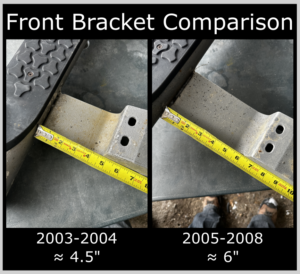 #
#
Measured examples confirm a clear difference in front arm geometry between early and mid-production OEM side steps:
- 2003–2004: Front arm offset is approximately 4.5 inches
- 2005–2008: Front arm offset is approximately 6 inches
This increased offset in the 2005–2008 design corresponds directly to the wider rocker panels introduced in 2005. Although all OEM side step versions will physically bolt to the vehicle, this offset difference is the primary reason early steps sit too close to the body when installed on later Elements.
2003–2008 (Welded-Arm Design) #
Step and Mounting Arms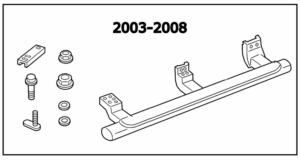 #
#
- The step body is an extruded aluminum component
- The mounting arms are also aluminum
- The mounting arms are welded directly to the extruded step
- The step and arms form a single integrated assembly and are not designed to be separated or swapped
Extension Bracket (Front) #
- Material: Black-coated aluminum
- Quantity: One per side
- Bolts to the front welded aluminum arm, then to the vehicle body
End Caps #
- One on each end of the step
- Material: Plastic
- Held in place with screws
2009–2011 (Modular Bracket Design)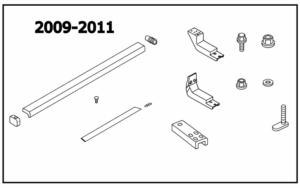 #
#
Step Bar and Mounting Brackets #
- The mounting brackets are separate from the bar
- Brackets are bolt-on, not welded to the step
- The step bar and brackets form a modular assembly
Appearance and Finish #
- Step bars are black and rectangular in profile
- A plastic traction (non-skid) pad is installed on the top surface
- The traction pad uses a different tread pattern than the 2003–2008 version
- By comparison, 2003–2008 steps use a similar black traction pad, but the aluminum step extrusion itself is silver/gray on early models
Rear Mounting (All Years) #
- The rear mounting location uses two specialty T-head bolts per side
- These bolts install head-first into the frame and use a plastic washer to keep it in place while lining the brackets up
- They are **difficult to source **if missing
- When OEM side steps are removed, these T-head bolts are often left behind in the vehicle, resulting in incomplete hardware when buying used sets
Rocker Panel Differences and Fitment Impact #
- 2003–2004: Narrow rocker panels
- 2005–2011: Wider rocker panels
All OEM side step versions will physically bolt up across model years. However, rocker panel width is the primary factor that determines how the step sits relative to the body.
As a result, mismatched step versions may:
- Sit too close to the body
- Sit too far out from the body
- Be partially tucked under or overly proud of the rocker panel
Even when installation is physically possible.
Switching Rocker Panels to Correct Fitment (2005–2008) #
A common issue occurs when 2003–2004 OEM side steps are installed on 2005–2008 Elements.
Result #
- Steps bolt on but sit too close to the body
- Partially nested under the wider rocker panels
- Reduced usability
OEM‑Correct Solution #
Installing 2003–2004 plastic rocker panels on a 2005–2008 Element restores proper step position.
Why this works:
- Early rocker panels are narrower
- They match the offset assumed by early OEM side steps
Installation notes:
- Rocker panels use the same clips and attachment points across all years
- Direct swap
- No drilling or modification required
References #
- Video: by Junked Elements: https://www.youtube.com/watch?v=H2Z0sGFKSDc
- Part links:
Key Takeaways #
- Honda produced three OEM side step variants for the Element
- All versions will physically bolt up across model years
- Differences in fitment are driven primarily by rocker panel width and body revisions
- 2003–2008: Extruded aluminum steps with welded aluminum mounting arms
- 2009–2011: Step bar with separate, bolt‑on mounting brackets
- The front extension bracket and rear T‑head mounting system is consistent across generations
- Swapping rocker panels is a valid OEM solution for correcting mismatched side step positioning
Suggest an edit to this article #
Spotted something incorrect, outdated, or unclear? Submit a correction or suggestion to help keep Elementopedia accurate.
Tip: If you can, include the section name and a source or link.
Submissions are reviewed before changes are made. Not all suggestions will result in edits.
Disclaimer & Use Notice
This article is provided for informational purposes only. Vehicle configurations, part availability, and repair procedures may vary by model year, trim level, region, and prior modifications. Always verify part numbers, specifications, and procedures using official manufacturer documentation, and consult a qualified technician when appropriate.
Vehicle modifications, repairs, and installations may be subject to local, state, or federal laws and regulations. Not all modifications described may be legal or permitted in all jurisdictions. It is the responsibility of the reader to confirm compliance with applicable laws and safety requirements before operating a modified vehicle.
The author and publisher assume no responsibility for damage, injury, loss, or legal consequences resulting from the use or misuse of information contained in this article.
Affiliate & External Links Notice
Some articles may include links to external products, services, or retailers. In certain cases, the owners or contributors of this site may have an affiliation with these vendors or may earn a commission from qualifying purchases made through such links. These links are provided for reference and convenience only and do not constitute an endorsement. Product availability, pricing, warranty terms, and return policies are determined solely by the external vendor.


