
Honda Element Paint Colors & Codes (2003–2011)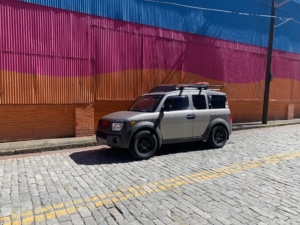 #
#
Overview #
The Honda Element was offered in a wide range of factory exterior paint colors between 2003 and 2011. These colors varied by model year, trim level, and market availability. Each factory color is identified by a specific Honda paint code, which is required when ordering touch‑up paint, repainting panels, or color‑matching replacement parts.
This article documents known Honda Element exterior paint colors, their official names, paint codes, and the model years in which they were offered.
Where to Find the Paint Code #
Honda paint codes are located on the vehicle identification label attached to the body.
Typical location:
- Driver‑side door jamb (body‑mounted sticker)
- White or silver sticker
- Paint code located below the bar code in the middle of the label
Example formats:
- NH‑700M
- YR‑525M
- B‑92P
The paint code is more reliable than the color name, as names are sometimes reused or described inconsistently by sellers.
⚠️ Important notes for Honda Element owners
- Doors may be swapped as part of a repair
- Repainted doors may be missing the sticker entirely
- A mismatched VIN between the door jamb sticker and the windshield VIN can indicate that a door was replaced during a prior repair
Paint Color List by Code #
Availability varies by trim and market.year availability as shown.
Neutral / Grayscale, Black, & Earth Tones #
| Color Name | Paint Code | Model Years | Notes |
| Alabaster Silver Metallic | NH700M | 2006–2011 | |
| Cargo Khaki | YR547 | 2005 | Single-year |
| Crystal Black Pearl | NH731P | 2009–2011 | |
| Galaxy Gray Metallic | NH701M | 2007–2008 | |
| Magnesium Metallic | NH675M | 2005 | Single-year |
| Nighthawk Black Pearl | B92P | 2003–2008 | |
| Polished Metal Metallic | NH737M | 2009–2011 | |
| Satin Silver Metallic | NH623M | 2003–2005 | |
| Shoreline Mist Metallic | YR528M | 2003–2004 |
Orange & Red #
| Color Name | Paint Code | Model Years | Notes |
| Citrus Fire Metallic | YR579M | 2009–2011 | |
| Midnight Red Pearl | R538P | 2009–2010 | SC only |
| Rallye Red | R513 | 2005–2006 | |
| Root Beer Metallic | YR569M | 2007–2008 | SC only |
| Sunset Orange Pearl | YR539P | 2003–2005 | |
| Tangerine Metallic | YR5863M | 2006–2008 | |
| Tango Red Pearl | R525P | 2006–2011 |
Blue & Green #
| Color Name | Paint Code | Model Years | Notes |
| Atomic Blue Metallic | B537M | 2006–2008 | |
| Eternal Blue Pearl | B96P | 2003 | |
| Fiji Blue Pearl | B529P | 2004–2005 | |
| Galapagos Green Metallic | G511M | 2003–2005 | |
| Kiwi Metallic | GY25M | 2006–2008 | |
| Omni Blue Pearl | B562P | 2009–2011 | |
| Royal Blue Pearl | B536P | 2008–2010 | 2008 SC only; 2009–10 all |
Single-Year Color Options #
The following colors appear in the reference chart for only one model year:
| Color Name | Paint Code | Model Year |
| Eternal Blue Pearl | B96P | 2003 |
| Magnesium Metallic | NH675M | 2005 |
| Cargo Khaki | YR547 | 2005 |
Exterior Plastic Panels (EX vs EX-P) #
One of the most visually significant differences in Honda Element exterior appearance is whether the vehicle uses unpainted textured plastic panels or body‑color painted composite panels. This distinction is most commonly seen when comparing standard EX models to EX‑P models.
EX (Unpainted / Textured Panels) #
Standard EX models (primarily 2003–2006) were equipped with unpainted, textured composite exterior panels. These panels were molded in color and not painted.
OEM documentation identifies three primary factory panel colors and their typical pairings:
- NH533 – “Bumper Dark Gray” (often described as black, but closer to charcoal)
- Paired with: Atomic Blue Metallic, Kiwi Metallic, Nighthawk Black Pearl, Rallye Red
- B535M – “Blue Metallic”
- Paired with: Alabaster Silver Metallic, Satin Silver Metallic
- NH661 – “EX Warm Gray”
- Used on all other 2003–2006 exterior colors equipped with unpainted plastic panels
These panels were designed to resist scratches and hide wear. Over time, they may fade or chalk but do not suffer clear‑coat failure.
EX‑P (Painted Panels) #
The EX‑P package replaced the textured panels with body‑color painted composite panels. These panels were painted to match the exterior body color and use the same paint code as the steel body panels.
Painted panels provide a more conventional, SUV‑like appearance but are:
- More susceptible to scratches and chips
- Subject to clear‑coat aging and peeling
- Less forgiving of color mismatch after partial repainting or panel replacement
Fading of Textured Plastic Panels #
Over time, the unpainted textured plastic panels used on early Honda Element models commonly experience UV‑related fading and surface oxidation. This process causes the panels to appear lighter, chalky, or uneven in color compared to their original factory finish.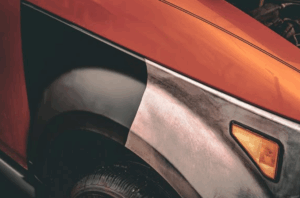
Fading is influenced by several factors:
- Prolonged sun exposure
- Environmental conditions and climate
- Frequency of washing and chemical cleaners
- Age of the material
While faded panels may appear worn, this condition is cosmetic only and does not indicate structural damage or failure of the panel material.
In many cases, faded textured panels can be visually restored through cleaning and the application of plastic‑safe restoration products designed to recondition oxidized surfaces.
For detailed guidance on restoring and maintaining faded Element plastic panels, see the related article on textured panel rehabilitation. (Coming soon)
Special Trim Notes #
Element SC (2007–2010) #
The following colors were only offered in the SC trim.
- Root Beer Metallic (YR569M) – SC only
- Midnight Red Pearl (R538P) – SC only
- Royal Blue Pearl (B536P) – 2008 SC only; 2009–2010 all trims
References #
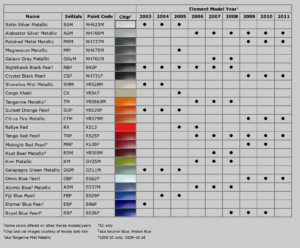
- OEM Honda Element exterior paint color reference chart (2003–2011) by https://www.ramblerdan.com/e/colors.htm
Key Takeaways #
- Honda Element exterior paint availability varied significantly by model year and trim.
- Paint codes are the only reliable method for color identification; color names alone are not sufficient.
- Early EX models used unpainted textured plastic panels, while EX-P models used body-color painted composite panels.
- Fading of textured plastic panels is a common, cosmetic aging issue and does not indicate structural failure.
Revision History #
- v1.0 — Initial article creation and chart-verified color tables
Contributors #
- Element DIY ElementDIY.com
- Rambler Dan www.ramblerdan.com
- David Joyce www.toasterparts.com
Suggest an edit to this article #
Spotted something incorrect, outdated, or unclear? Submit a correction or suggestion to help keep Elementopedia accurate.
Tip: If you can, include the section name and a source or link.
Submissions are reviewed before changes are made. Not all suggestions will result in edits.
Disclaimer & Use Notice
This article is provided for informational purposes only. Vehicle configurations, part availability, and repair procedures may vary by model year, trim level, region, and prior modifications. Always verify part numbers, specifications, and procedures using official manufacturer documentation, and consult a qualified technician when appropriate.
Vehicle modifications, repairs, and installations may be subject to local, state, or federal laws and regulations. Not all modifications described may be legal or permitted in all jurisdictions. It is the responsibility of the reader to confirm compliance with applicable laws and safety requirements before operating a modified vehicle.
The author and publisher assume no responsibility for damage, injury, loss, or legal consequences resulting from the use or misuse of information contained in this article.
Affiliate & External Links Notice
Some articles may include links to external products, services, or retailers. In certain cases, the owners or contributors of this site may have an affiliation with these vendors or may earn a commission from qualifying purchases made through such links. These links are provided for reference and convenience only and do not constitute an endorsement. Product availability, pricing, warranty terms, and return policies are determined solely by the external vendor.


